

by Dustin Durrett
Julien Reverchon was born on August 3, 1837, in Diémoz, France, to Jacques Maximilien and Florine (Pete) Reverchon. He grew up alongside his brothers, Elisée and Paul-Alphonse, in a household that nurtured curiosity about the natural world. From a young age, Julien displayed a passion for botany, and together with his brother he assembled a remarkable childhood collection of nearly 2,000 plant species. This early devotion to nature laid the foundation for the career he would later pursue in the United States.
At 19, Julien and his father emigrated from France to join the Fourierist utopian colony at La Réunion in Dallas County, Texas. The community, founded by French philosopher Victor Prosper Considerant, was already faltering by the time of their arrival in December 1856. Soon after, the colony formally dissolved. In exchange for their shares in the failed enterprise, Maximilien Reverchon received a plot of land on the colony’s southeastern edge. There, the family established a farm, and Julien turned his attention to the unfamiliar plants of North Texas, beginning his lifelong study of the region’s flora.
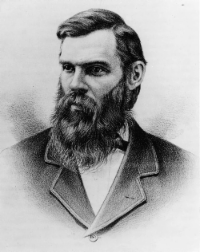
On July 24, 1864, Reverchon married Marie Henri. The couple had two sons, but tragedy struck in 1884 when both boys died of typhoid fever. After a period of stepping away from botany, Reverchon returned to scientific work in 1869. That year, he joined Jacob Boll on an expedition to collect fossils in West Texas. Revived in his passion, he went on to assemble extensive plant collections that were later studied and utilized by leading American botanists, including Asa Gray and Charles Sprague Sargent. His specimens were widely distributed through Allen Hiram Curtiss’s North American Plants series, ensuring that Reverchon’s discoveries reached herbaria and research institutions across the country.
In his later years, Reverchon shared his knowledge by teaching botany in Dallas. By this time, he had amassed an extraordinary herbarium at his home, known as the Rose Cottage. The collection contained more than 2,600 species and over 20,000 specimens—an invaluable record of the biodiversity of Texas.
Tragedy struck once again in July 1905. While examining insects near a railroad track in Greenville, Texas, Reverchon was struck by a passing train. He sustained a fractured arm and severe back injuries. Though he survived the initial accident, he never fully recovered. On December 30, 1905, Reverchon died at the home of his adopted son, R. M. Freeman.
Julien Reverchon was laid to rest in La Réunion Cemetery, not far from the site of the colony where his American journey had begun nearly 50 years earlier. His legacy endures not only through the thousands of specimens preserved in botanical collections but also in the recognition he continues to receive as one of the most influential naturalists of early Texas.
Get future posts by email.