
The flying red horse Pegasus should be a well known image most likely to everyone who is at least 40 years old. For decades, it was the trademark of Mobil gas stations and other Mobilgas products and facilities. Prior to 1911, the Standard Oil Company was the largest oil company in the world. It was founded by John D. Rockefeller in 1863 as the Standard Oil Trust and within a few years it had become a company that dominated the oil industry in the United States. The Sherman Antitrust Act of 1890 was enacted to help prevent monopolies from controlling too much of the U. S. economy. The Standard Oil Company was declared a monopoly under the Act and was ordered by the U. S. Supreme Court to break itself up into seven different “state” companies in 1911, similar to the action that was required of AT&T several decades later.
The Standard Oil Company of New York, known as Socony, was one of those seven companies. Another was the Vacuum Oil Company. Socony’s logos included a symbol that resembled a torch. The Vacuum Oil Company used the trade name Mobilgas for its products. A logo of the Vacuum Oil Company of the later Socony Vacuum was the winged horse of ancient mythology, Pegasus. The two companies merged in 1931 to become the Socony Vacuum Company. The familiar flying red horse was trademarked and began to be used on Mobilgas products. The red Pegasus image had earlier been developed by an artist in the Mobil Sekiyu division in Japan and was updated in the 1930s by commercial illustrator named Robert Elmer. It widely appeared in signage, on advertising novelties, on petroleum products and all around the company’s many service stations.
In 1911, the Magnolia Petroleum Company was founded in Texas by the Sealy family of Galveston, Texas and was the consolidation of several smaller companies. George Sealy’s wife was the former Magnolia Willis but at this point, no one is quite sure of the origin of the company name. One legend allows that a Pennsylvania shareholder named C. N. Payne was at the organizational meeting in 1911 when he happened to gaze out the window at some trees bearing beautiful white blossoms, wondering what they were called. When told that they were magnolia trees and blossoms, he proposed Magnolia for the company name and the blossom for the logo. In any case, Magnolia Petroleum merged with Socony in 1925, a few years before the Socony – Vacuum Oil merger. Magnolia’s logo was a magnolia blossom. After the merger, Magnolia continued to operate as a subsidiary of Socony and then Socony-Vacuum before being completely incorporated (with a loss of its corporate identity) in the late 1950s.
In the 1930s, the company headquarters were in the newly completed Magnolia Building in Dallas located at Akard and Commerce streets. At the time, the building was Dallas’ first skyscraper, was the tallest building in town and was for a time the tallest structure west of the Mississippi. No doubt many Texas families include individuals with ties to Magnolia, Mobil or one of the other affiliates.
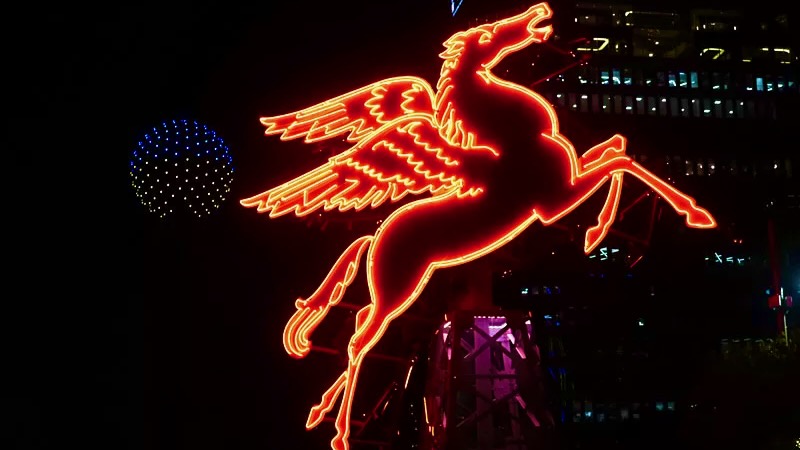
A local Dallas company, Texlite, Inc., was commissioned to build a sign to adorn the top of the Magnolia Building. Construction took an amazingly short six weeks at the company shop at the former location in the Fair Park area. Texlite, owned by Harold Wineburgh, was known for doing signs of all kinds, including numerous tall theater signs around the state. Texlite delivered the two sided sign in time for the American Petroleum Institute’s first annual meeting that was held in Dallas in November of 1934. The brand new sign sat on a tower that resembled an oil derrick. Back in the day, it also rotated atop the building.
Motorists and airline passengers alike would look for the iconic sign as they approached the city. Not all viewer comments were complimentary, however. In the spirit of the long time rivalry between the two cities, Fort Worth publisher and avid Dallas critic Amon G. Carter is said to have remarked while flying over downtown that “Everybody knows that Dallas is a ‘one horse’ town. I can’t see why they have to advertise it.” Despite detractors like Carter, and probably much to his chagrin, the famous sign endured to became a familiar, beloved North Texas landmark.
The original sign remained in place until 1999. By then, it no longer rotated and the neon lights had failed two years earlier. After having suffered the ill effects of exposure to the Texas weather, the sign was retired and stored. The old sign was used as a template for a new one constructed by the Porcelain Enamel Company of Dallas in a $600,00 project financed by corporate and individual contributions. On New Year’s Day, 2000 the new 15 ton sign was installed, hopefully engineered to last many more decades.
Dallas adopted the Pegasus image. In 2001, the Dallas Soars Project was instituted to place 200 stylized Pegasus statues around the city, some of which remain in public view. The project was a collaboration between local artists, supporters of the arts and the City of Dallas. The statues went on display September 15, 2001 at hotels, businesses and various other venues around town.
Many years later, the original sign from the Magnolia Building was renovated and restored, which is a great story of its own. In 2015, the beautifully renovated Pegasus was reinstalled in front of the downtown Omni Dallas Hotel, where it currently resides.
Get future posts by email.