
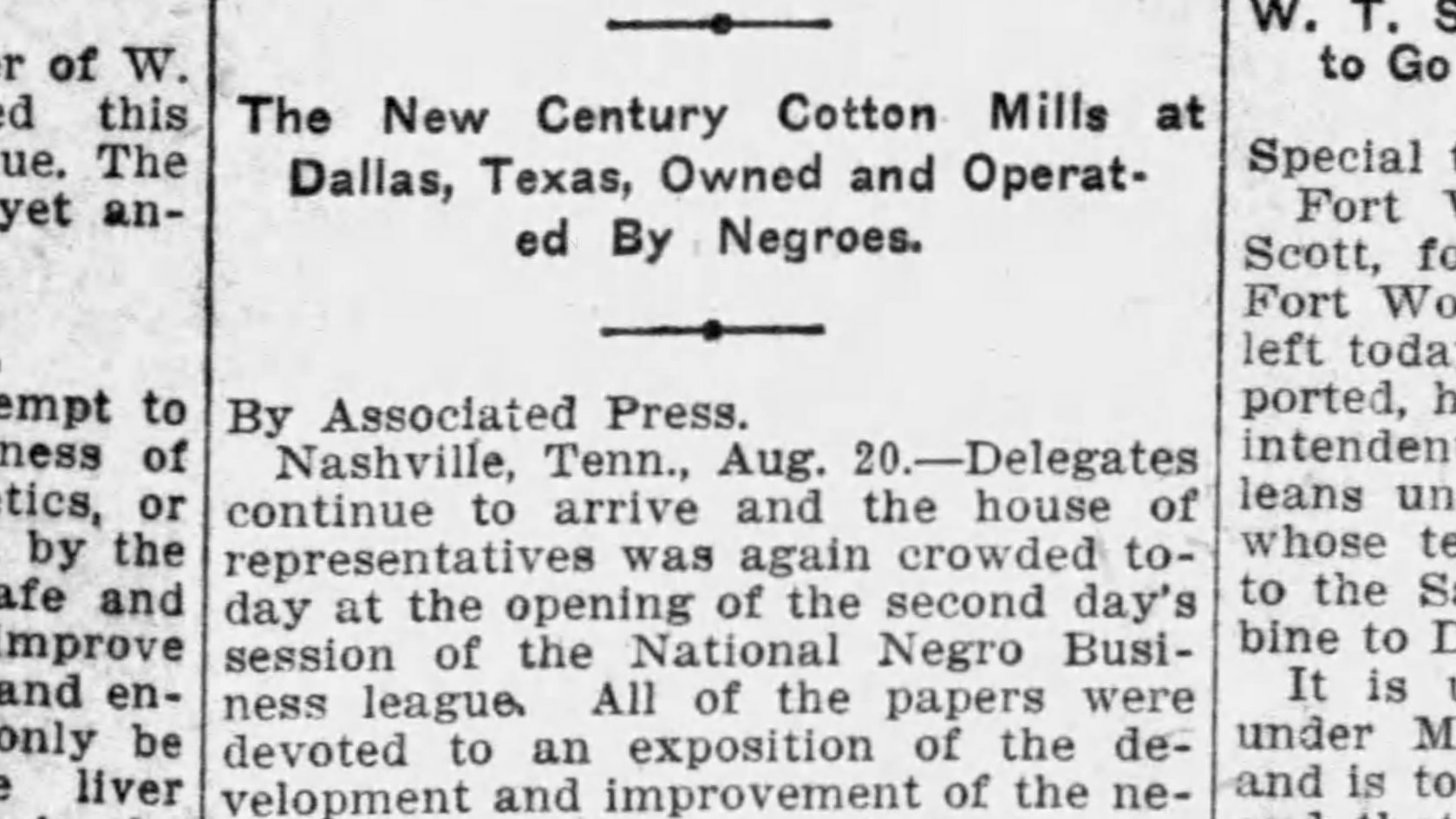
New Century Cotton Mills of Dallas, an ambitious project conceived around the turn of the twentieth century, was incorporated with the Texas Secretary of State in 1901. The following public notice was reported in the San Antonio Express-News on June 4, 1901.
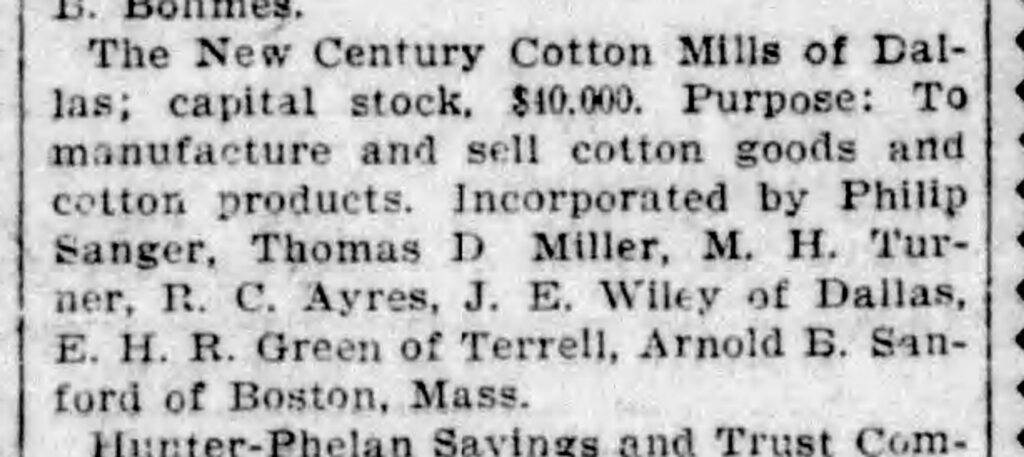
The incorporators were Phillip Sanger, Thomas D. Miller, M. H. Turner, R. C. Ayers, J. E. Wiley, E. H. R. Green and Arnold B. Sanford. About two months later, a ceremony was held downtown just off the Houston & Texas Central rail line laying the cornerstone for the new enterprise’s first building, slated to cost $50,000. Grand Master J. W. McKinney of the grand lodge of negro Masons of Texas had come from Sherman to conduct the ceremony. The festivities included a parade by Company A of the 25th United States Colored Infantry, organized as a “Buffalo Soldier” regiment after the Civil War.
H. W. Scott was an African American businessman in Fort Worth who had operated grocery and general merchandise businesses. Phillip Sanger was one of the Sanger brothers who had set up the Dallas mercantile business of the same name. Sanger was one of the backers of the Houston & Texas Central’s expansion northward through Texas. Joseph E. Wiley was a local real estate investor and was known as the first formally educated African American lawyer in Texas. Other incorporators included Edward Green, son of eccentric investor Hetty Howland Green. Mr. Green had many interests, including railroads, and was an investor and philanthropist out of New York. Arnold B. Sanford of Boston was president of the American Cotton Yarn Exchange. Local investors were said to have included members of the Munger family, C. C. Slaughter, Pastor Alexander Stephens Jackson of New Hope Baptist Church and many others.
Construction soon began near the current site of Booker T. Washington High School between Flora Street, Juliette Street and the Houston & Texas Central rail lines. The property encompassed around four acres. The company endeavored to employ African American men and women. It operated for several years as one of the smaller cotton mills in Texas until its business dwindled to the point where bankruptcy loomed. New Century filed a petition for bankruptcy in early 1907 and the ambitious project ceased operations.
On February 7, 1907, the Fort Worth Record and Register reported that the Texas Savings Trust company had prevailed in its petition to the Fourteenth District Court to have a receiver appointed in connection with the bankruptcy of New Century Cotton Mills. J. N. DuBoise was named as receiver.
Later that year, Shwartz Brothers of Corsicana acquired the machinery of New Century Cotton Mills with a view to expanding its operation. A newspaper article on June 15, 1907 in the Houston Chronicle reported the transaction, stating that a brand new mill would be built in Corsicana with brick from Texas Fire Brick Company of Elgin. The new facility was to employ 200 people with a total payroll of about $40,000.
Although the New Century endeavor ultimately failed, it is noted for having been a cooperative multiracial effort, created to benefit the Dallas County African American community.
Get future posts by email.