
By Brian Gunn
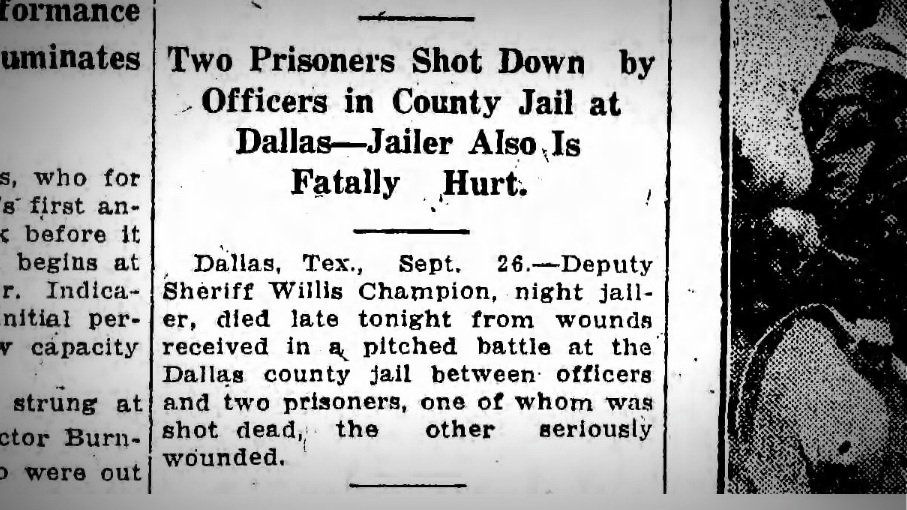
Two prisoners were shot down, one fatally, and a Sheriff’s Deputy slain in a fierce shoot-out as the result of an attempted escape at the Dallas County Jail.
Prisoners C.E. Gaines and Sidney “Pete” Welk attempted to overpower night guard Deputy Willis Champion, but a spectacular firefight ensued that left both prisoners shot, one fatally, and also killed Deputy Champion.
Around 8 p.m., Deputy Sheriff Willis Champion had just secured an inbound prisoner to his cell when Gaines and Welk, armed with pistols, attacked him. Champion was opening the tank door when the two surprised him and attempted to wrestle away his keys. When Champion resisted they opened fire. As he fought his way backwards out of the tank door, they shot him in stomach, but not before he managed to throw his keys out the 6th floor window preventing their escape.
Ozie Davis, the elevator operator who had just taken Deputy Champion and his prisoner up to the 6th floor “showed wonderful presence of mind” by running the elevator back down to the ground floor to notify other officers of the attack. Six deputies armed with shotguns and pistols were immediately lifted to the 6th floor and began exchanging fire with Gaines and Welk, who had already mortally wounded Deputy Champion. It only took moments for prisoners to be shot down, killing one and critically wounding the other. Gaines was killed almost immediately but Welk had retreated under a stairwell before being shot in the chest and the face.
Prisoners on the 6th floor, who witnessed the shooting, cowered in their cells to avoid the barrage of bullets. An automobile, said to have been driven by a woman, circled the jail during the shootout and was thought to have been used to help the accomplices escape. Deputy Champion later died at Baylor Hospital from wounds received in the gun battle.
Welk was serving a forty year sentence for complicity in the killing of an officer who raided his bootlegging business. Welk and 3 others were at their still in the woods on lower Rowlett Creek when they were surprised by sheriff’s deputies Hilliard Brite and Tom Wood. A shoot-out ensued and Deputy Tom Wood was fatally shot. Two of the men were taken into custody shortly after the killing, the third was taken the next morning, but it was Pete Welk with whom officers expected a gun battle to the death would be fought. Welk was later captured and jailed.
It was during his time being held in the Dallas County jail that he formed a close friendship with Charles Gaines. Gaines was under a death sentence for the Jan 14, 1921 Jackson St. Post Office robbery in which postal clerk George Street was killed.
But even before the appeal of his 40-year sentence for the Tom Wood killing, Welk went to trial for the murder of Deputy Champion. He was convicted on October 22, 1923 and sentenced to execution in the electric chair. In February of 1924 the Garland News reported that Pete Welk, still in county jail, was seriously ill. Three months previously his mind had become affected; he refused to speak to anyone and apparently didn’t recognize his wife. Shortly thereafter he was pronounced to be insane. Now during the night he had suffered some sort of seizure and began calling out for Gaines, his accomplice in the attempted escape. The next day he would not talk, but mumbled to himself.
The date of Welk’s appointment with the electric chair in Huntsville was set for April 3, 1925. The state board of pardons refused to intervene and a last-minute petition for a writ of habeas corpus to the federal court of appeals was rejected.
By the time of his execution Pete Welk’s infamy had spread nationwide. There was almost more coverage of Welk’s pitiful family, than the crimes he committed. Welk and his wife, Willie, had five children at the time of Pete’s execution: Olan, 11; Pauline, 9; Vera, 7; Talmadge, 6; and Joy, 3. The family rented a two-room shack on a farm in the Chiesa neighborhood owned by Millard Flook, of Garland, who only a few days earlier announced that he had rented the farm to someone else and the Welks would have to vacate.
Willie Welk told the reporter, “I have done all I could. No one can say that I haven’t stood by Pete in his troubles. I have sold everything that we owned to try to save his life—and all for nothing.
Welk’s youngest daughter Joy wanted to go visit him: “I know we haven’t got a car, but we could walk since it is not very far.” And Vera asked, “How are we going to have a funeral for Daddy, Ma? I thought funerals were for dead people.” Stories like this in the Dallas paper touched the hearts of readers and donations to the family began arriving from far and wide. The Rowlett bank even set up a trust fund for them.
On the day before his execution Welk was visited by the Dallas County sheriff, Schuyler Marshall, who hoped to persuade him to reveal who supplied him with the gun used in his attempted jail break. Welk said nothing. As Welk was seated in the electric chair the Sheriff again asked him to reveal the source of the smuggled weapons but he replied that he wished he could but that he could not. And with that, the switch was thrown and Pete Welk became the first white man electrocuted in the state of Texas. He is buried in Big A Cemetery in Rowlett.
Deputy Sheriff Willis Champion is buried in Oakland Cemetery and remembered at the Dallas County Sheriffs Fallen Officer memorial in Founders Plaza at Market and Main. His great-grand-daughter lives in Dallas.
Pete Welk’s Great-grand-nephew is a Rowlett Police Detective.
Get future posts by email.