
Gerrit Van Ginkel was an investor who specialized in creating street car systems. He was born December 11, 1849 in the Netherlands. He came with his parents to the United States around 1855. By 1860 they had settled in Pella, Iowa. The family consisted of his father (a laborer), his mother, Gerritt and four other siblings. Gerrit was industrious. He learned to be a printer by serving as an apprentice as a youth and established his own periodical publication when he was 18. Van Ginkel went on to operate several different businesses over the years while living in Iowa, including a farming/gardening business. He found coal on his property and expanded that into a coal and brickmaking business. Van Ginkel had also made some successful real estate investments, one of which was the Observatory Building in Des Moines. In the mid 1880s, he also acquired the horse drawn streetcar system in Des Moines with some other investors who later converted it to electric power. Around 1890, he developed an electric railway system in Springfield, Illinois.
He had married Katherine Maria Tenhagen in 1867 and the couple had around ten children, most of whom lived to become adults. In 1894, he lost his eyesight. He received a blow to his temple as he was playing with his children. His injury, possibly a blood clot that affected his optic nerve, resulted in his blindness for two months. Then one night he awoke at 2:00 a.m. and he could suddenly see again. As the decade came to a close, his wife and one child died in 1898. Several months later he remarried Josie Henkle.
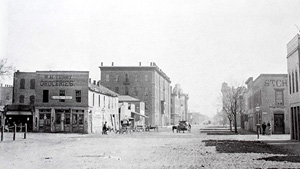
Van Ginkel and family moved to Dallas around 1899, a few months after his second marriage. He became a co-owner of the local horse-drawn street railway system. The group’s first attempt at electrification was to build a rail line that ran from downtown to Exall Lake which was then primarily a recreation area created by building a dam on Turtle Creek. It has since been reduced to a slender waterway to accommodate residential development.
The electrification of Dallas streetcars was proving to be a success allowing Van Ginkel and the other investors to sell their interests in June of 1901. Van Ginkel made plans to move on to the next project, a new rail system in Omaha, Nebraska. A couple of weeks after the Dallas sale closed, Van Ginkel and his family had ridden one of his streetcars out to Exall Lake to attend a picnic. Late that night the party was waiting on a car to take them home around 10:30. The streetcar had still not arrived by about 11:00, so Van Ginkel and a friend started walking down the tracks to see what might be the problem. The friend was a bit ahead of Van Ginkel and boarded the car when it met him. A short time later, the car was rolling down a sloping grade when it struck Van Ginkel. He had apparently sat down on the tracks and dozed off while waiting for it. Some accounts note that power was low and the car’s exterior lights were dim, but Van Ginkel was mortally wounded in the accident. He was transported downtown with his family, but died before help could arrive.
Van Ginkel was survived by his widow and several children. An obituary noted that when he died, he was also an executive of Mammoth Oil Company which had operations in Dallas and Beaumont. His remains were returned to Des Moines, Iowa for burial.
By Mike Magers