
“Bridging” the Gap Between Mule-Drawn Coaches and Electric Streetcars
Streetcars began to run in Dallas around 1873. Captain G. M. Swink was President of Dallas City Railroad Company. One of the first configurations used mule drawn coaches. In the very early days there were two coaches, one named for John Neely Bryan and the other named for Belle Swink, daughter of Capt. Swink. The lines in Dallas were not converted to electric power until around 1889.
A few years earlier, interest had begun to rise regarding a means to connect the new town of Oak Cliff to Dallas via rail. Around that time, the Dallas and Oak Cliff Railway Company was founded by Thomas L. Marsalis and John S. Armstrong.
Marsalis was born in 1852 in southwestern Mississippi, near New Orleans, Louisiana. When he was still a young man, he moved to Dallas and opened a wholesale business that became quite successful. John S. Armstrong was born in 1850 in Tennessee and came to Texas to operate a wholesale meat business with members of his family. Marsalis formed a partnership with Armstrong. They had a vision for establishing a town in what was previously vacant land across the Trinity River from Dallas. The two laid out streets and are considered to be the founders of Oak Cliff.
The rail system they created primarily served Oak Cliff (now part of Dallas). It provided surface transportation and also crossed the Trinity River. Its name was later changed to the Dallas and Oak Cliff Elevated Railway Company, though very little of it was “elevated” in the traditional sense. It operated for about 15 years until 1902 when it was acquired by the Northern Texas Traction Company, an interurban company that also operated a rail line between Fort Worth and Dallas.
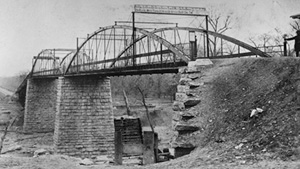
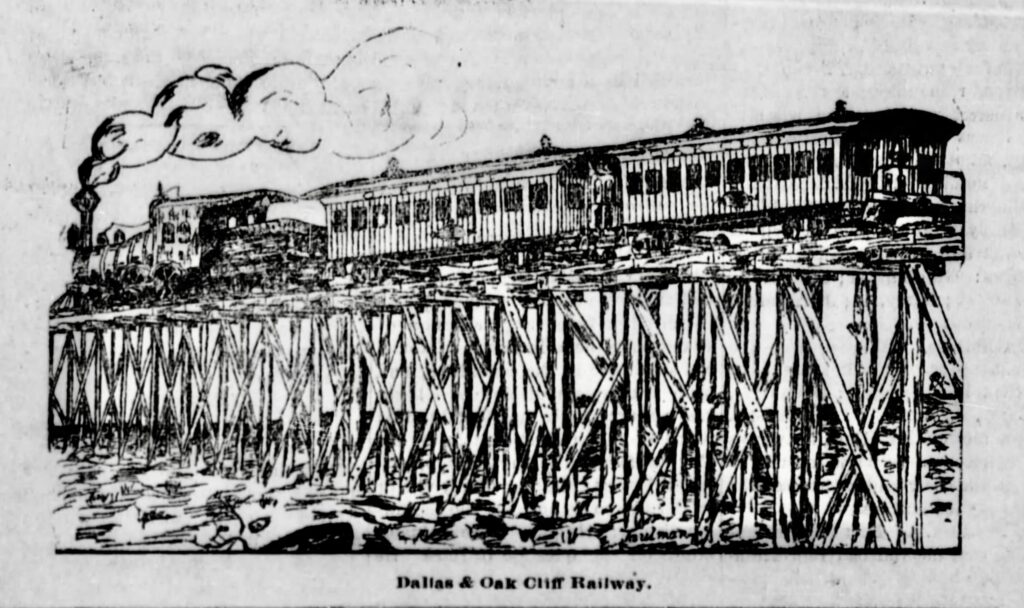
During its lifetime, the Dallas and Oak Cliff Elevated Railway Company used small steam locomotives for power. An article in the Dallas Daily Herald issue of December 29, 1887 noted that the Trinity was crossed by means of a temporary wooden bridge, but that a new iron bridge was nearing completion. The newspaper had no photographs but included the sketch below that illustrated how the locomotive and two cars looked.
By Mike Magers