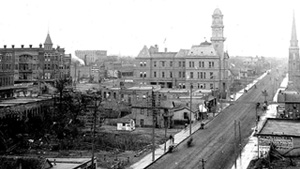

The Knights of Pythias is a charitable/fraternal organization with a rich history. Founded in 1864 by Justus H. Rathbone and chartered by the U.S. Congress, it began operating its first lodges in the 1860s, originally limited to Anglo members. In 1880, Thomas W. Stringer and associates established the Knights of Pythias of North America, South America, Europe, Asia, Africa, and Australia in Mississippi. This group, often called the Colored Knights of Pythias, was created for African American men but was open to all races. At its height, it boasted around 200,000 members, creating a vibrant community.
The name Pythias comes from the Greek legend of Damon and Pythias. In the legend, the two are friends. Pythias is condemned to death by the tyrant Dionysius of Syracuse. Damon offers to die in his place if Pythias does not return by a certain date. The legend concludes with Pythias’ return, after which Dionysius pardons them both.
The Pythian organization typically included a Grand Lodge in each state under which the local lodges were aligned. Over the various Grand Lodges, a Supreme Lodge was positioned. The crest of the order was an inverted triangle with capital letters F, C and B, which stood for friendship, charity and benevolence. The Texas Grand Lodge was organized in 1885 and membership grew across the state. A large number of lodges existed in Texas after 1900.
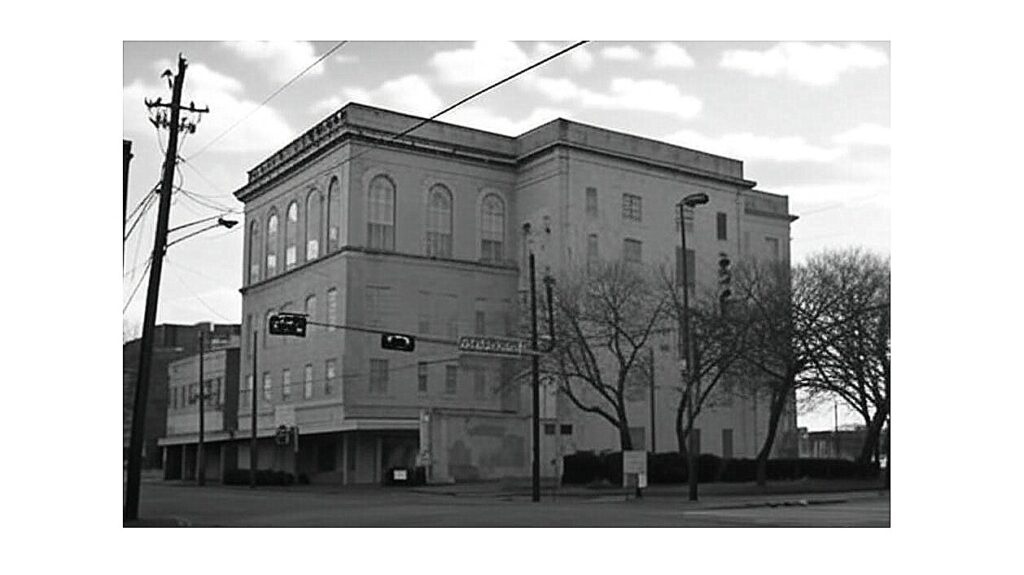
The building known at various times as the Pythian Temple, Colored Knights of Pythias Temple, Union Bankers Life Building was built in 1915-1916. Its architect was William Sidney Pittman, the first African-American architect in Dallas. Pittman was the son in law of Booker T. Washington. The building remarkably survived many changes in the Dallas downtown area for over one hundred years.
Its architectural style is called Beaux-Arts, said to be of peak popularity from the late 1890s to around 1920. The following is an excerpt from the 1984 historic landmark application filed with the City of Dallas.
[The building] is characterized by dramatic movements in scale and form, with classical ornament applied for theatrical effect. Built in 1915-1916, the design follows the classical Greek influences. The architect used classical proportions by employing a base, shaft and capital, with the divisions being distinguished through the use of cornices to give the desired monumental effect. Box dentil and egg-and-dart motifs on the second cornice, a foliated scroll detail on the parapeted pilaster wall and arched windows ending with dentil details on the first cornice are classical elements in the structure. The dramatic scale is greatly enhanced by the keystone-centered, arched windows, which extend across the front facade and on two sides.
The Pythian Temple exhibits the same classical elements which can be found in other buildings Pittman designed.
Upon its completion, the building was a cultural center for the nearby African American community, hosting various types of events. It also offered office space to physicians and other businesses. The Grand Lodge of Texas had its headquarters in the building. For many years, the building saw regular use, but due to the group’s decline, it was sold to a private investor in 1946. It is believed to have changed hands at least once more until it was acquired in 1959 by Union Bankers Life Insurance Company. This company occupied the structure as its office for several decades before relocating to a downtown high rise building. The beautiful building stood vacant for many years until it was made part of a hotel project.
By Mike Magers