
[Transcribed from Galveston Daily News, June 1, 1895, Page 2]
The Pioneer, Legislator, Soldier and Citizen, Passes to His Long Rest
A SKETCH OF HIS CAREER
He Was Well Known Among the Great Men Who Have Contributed to Make Texas Great
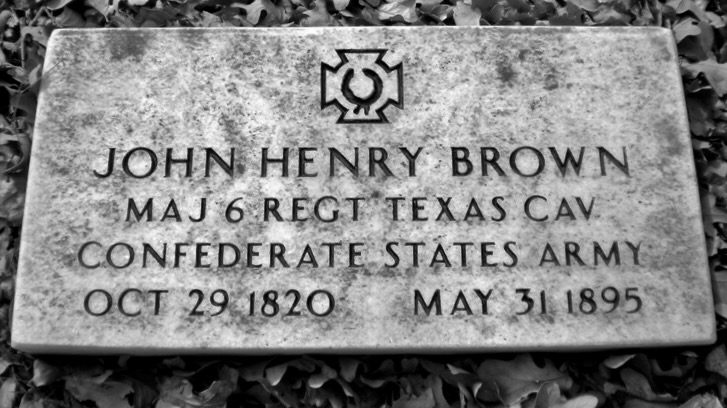
Dallas, Tex., May 31. – John Henry Brown is dead. Surrounded by family and friends, at his residence on Pearl and Live Oak streets, the long, eventful life of the aged pioneer, journalist and historian came to an end tonight just as the clock was chiming the hour of 9. He had been ill only since last Sunday. but from the time he became confined to his bed the bronchial infection, from which had suffered for some time past, made such inroads upon his strength that it was evident, a day or two that the end was not far distant.
John Henry Brown was prominent in the annals of Texas as a pioneer, legislator, soldier and citizen. He was born in Pike county, Missouri, October 20, 1820, five months before that territory became a state. His parents were both natives of Kentucky. The orignators of the family in this country came across the ocean in the time of Lord Baltlmore. The great grandfather and grandfather of Colonel Brown was born in Maryland and fought in the revolutionary war. Captain Henry S. Brown, Colonel Brown’s father, came to Texas in 1824. He distinguished himself in many battles with the Indians and in other public service to Texas. He died in Brazoria in 1834, his wife surviving him until 1861. Brown county, created in 1856, was named after Captain Henry S. Brown. John Henry Brown worked on the farm until 12 years old and then entered a printing office in his native county under the guidance of A. B. Chambers, who afterward so long and ably edited the St. Louis Republic.
His first residence in Texas was with his uncle, Major James Kerr, on the Lavaca river, where he mingled with the young men of the country and acquired a practical knowledge of Texas border life. When Austin was laid out in 1839 he repaired to the new seat of government in order to work on one of the newspapers there. In the winter of 1839-40 he was one of a company of volunteers who pursued the Indians who had made a raid on Austin. The next year her returned to his uncle on the Lavaca river and there took part in the “Archer” and other expeditions. With his brother, Rufus E. Brown, he aided in the opening of a farm for his brother in what is now Lavaca county. In 1841 he was first sergeant of a corps of minutemen. He was one of the volunteers who, under Captain John C. Hayes, evacuated San Antonio. Afterward he served as a scout and picket against Mexican and Indian surprises. As a lieutenant he participated at the battle of Salado, in which he received a wound in the hip which since gave him considerable trouble. He afterward participated in the unfortunate Somervell affair and returned home barefooted and nearly naked and almost dying from wet, cold and hunger.
After assisting in putting in a crop, Colonel Brown left in 1843 for a trip to St. Louis. There he met and married the same year Miss Mary Mitchell of Groton, Conn., an educated and accomplished lady of one of the oldest and most highly respected families in New England. The winter of that year was spent in Missouri. Colonel Brown lay at death’s door with the malignant disease called “black death,” which fastened upon his lungs and rendered him unfit for active labor for several years. Returning to Texas, he remained for some time at his mother’s, where his first child, Julius Rufus, was born February 4, 1846. Later in the same year, when the Victoria Advocate was started, he removed to that place and was employed on that paper assisting in its editorial department. When the militia of the new state of Texas was organized in 1846, about the commencement of the Mexican war, he was appointed brigade major of the southwest with the rank of colonel, and held the position for four years. In February, 1848, he removed to the new town of Indianola, and until 1854 was an active and zealous worker in the interests of that place, holding various positions of trust, including that of commissioner of deeds for twenty-three states in the union. He also founded and edited the Indianola Bulletin, a widely circulated and influential journal. During this time he was a contributor to DeBows’ Review, under the general title of “Early Life in the Southwest.”
During the time from annexation in 1845 to 1861 he became a thorough disciple of states rights, as held by the sage and apostle of liberty, Thomas Jefferson, which beliefs were the cornerstone of his political actions from that time until succession occurred.
In 1851 he purchased an interest in and became co-editor of the Galveston Civilian, but the late Hamilton Stuart, his senior associate, the former founder of the paper and one of the ablest of writers, held the position of United States collector of customs, and the larger share of editorial labor devolved on Colonel Brown. He manifested such ability that he was nominated for the house of representatives and began his career as a public speaker with such effect that he was considered the foremost man when the votes were counted. Colonel Brown was an active, laborious and conscientious worker in the legislature, never speaking over five minutes and only on subjects on which he could throw light, always watchful for the interest of his constituency, yet an attentive listener, anxious to understand the bearing of every question discussed upon the permanent good of Texas. That his course was eminently satisfactory to his constituency was proven by his unanimous nomination before his return home and his triumphant election a few days after his arrival as mayor of Galveston, a position he neither sought nor desired.
Under his first administration the streets were improved, the laws of the city revised and published, and many abuses were corrected. One of these was the giving the mayor a fee of $2.50 for each conviction before him and none for acquittal., which Colonel Brown denounced as a bribe, refusing to touch money so received, and he introduced the council to strike this law from the municipal code. At the expiration of his term in March, 1857, he was re-elected without opposition. During his second term public improvements continued. In September, 1857, he was elected by the democratic party to the house of representatives once more. When the session commenced Colonel Brown resigned the mayoralty and took his seat in the legislature for the third time. In the senate were Mark M. Porter, E. A. Palmer, M. D. K. Taytlor, I. A. Paschal, Wm. M. Taylor, Wm. T. Scott, Jesse Grimes, John Cadwell, Ben E. McCulloch and others of acknowledged ability. In the house were Ben E. Tarver, John Sayles, James E. Shephard, Wm. H. Ochiltree, Charles L. Cleveland, Charles S. West, Hamilton P. Lee, Frank W. Latham, J. W. Throckmorton, Ashbel Smith, Stephen S. Tompkins, Josiah P. Crosby, Jacob Wachler and others afterward prominent in the state. During the session Colonel Brown received an injury from a fall that was destined later to require a surgical operation. His health continued to decline that in March 1858, he sold his interest in the Civilian and his home in Galveston and moved to Belton, with the view of converting his means and recovering his health in stock raising.
About the last of 1853 the Belton Democrat was founded and Colonel Brown became its editor and so continued until secession was accomplished in 1861.
He was elected a delegate to the secession convention from the district of Bell and Lampasas, not a single vote being cast against him. The convention met on January 29, 1861, and on February 2 the ordinance of secession was passed. Colonel Brown continued an active member of the body until final adjournment, March 25, by this time he was in such a condition from the injury just mentioned that a surgical operation was performed in Belton in July. In August he left for General Ben McCulloch’s headquarters in Missouri and served on the staff until the general’s death. He was appointed adjutant general on the staff of General Henry E. McCulloch. Owing to ill health he returned to Texas in 1863. In the summer of 1864 another surgical operation was performed. Soon afterward he removed with his family to Mexico and was appointed chief commissioner of immigration by the imperial government. In March, 1866, he was commissioned to explore and report on the country along the Panero river. In the spring of 1869 Colonel Brown made a trip to New York and New England on a mission to the purchase of improved arms for the Mexican government. In March, 1870, he proceeded with his family once more to Indianola, Tex. From April until November he delivered over 100 addresses in the northern and New England states in aid of the reform society in Mexico. He declined further service and rejoined his family in 1871. On July 17, 1871, he located in Dallas.
In 1872 he was nominated unanimously by the democratic party to the legislature for the district of Dallas, Tarrant and Collin. He was elected by over 2000 majority. He returned home in 1873 to witness his oldest son’s (Julius) death. He immediately withdrew as much as he could from public life.
In 1875 he was elected a member of the constitutional convention for Dallas, Tarrant and Ellis counties.
In 1875 he received another blow in the death of his other son. In 1877 and again in 1879 he was on the frontier, his wife and daughters accompanying him in the former year. In 1880-81 he was employed as revising editor of the Encyclopedia of the New West. In the autumn of 1881 he was appointed by the governor commissioner to superintend for the state the survey and location of school lands, and entered on his duty in 1882.
In 1884 he was alderman and mayor pro tem of Dallas. In 1885-86 he was mayor of Dallas, and in 1888-89-90 was a city judge.
Get future posts by email.