
Dallas Railway & Terminal Days
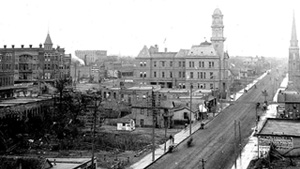
After I graduated from College in 1937 I went to work at the Dallas Railway & Terminal Company as a laborer in the warehouse division of the maintenance department. In that capacity I unloaded railroad boxcars loaded with railroad spikes as well as creosoted ties used in the repair of the Street Car tracks. We also grunted (helped) the Lineman who climbed the creosoted poles that held the cables that provided the electricity that operated the Street Cars. Many times we would work on the rails and repaired the switches during the heat of the day or at times we would work at night when the cars were not running.
A friend of the family, Cecil Williford, was very helpful in getting this job, as jobs as this were very hard to get. They paid .45 cents per hour and we got paid on the first and fifteen of each month. We worked 50 to 60 hours per week as there no overtime requirements during this era.
After about a year I was given an opportunity to start training as a Street Car Operator. The pay for that job started at .60 cents per hour and your hours were very irregular. After a training period of about 45 days I was assigned as an extra operator in the East Dallas division. The operating office of that division was at Peak Street and Elm Streets where the streetcars were maintained and where all runs started out. The Oak Cliff division operated out of Oak Cliff. The Extra Board was the same for each division. We were required to show up at 5 AM and wait until someone did not show up or wanted off. Then we would make his run. Most of the runs (scheduled) lasted about 7 to 9 hours. We were only paid if we made a run. If we had a good 2 weeks we could make as much 80 to 90 dollars and that was very good money. The only deductions we had at that time was Social Security and that was so very small we did not notice it. They were no deductions for WH Tax for Income Tax since none of us paid Income Taxes.
A few of the East Dallas runs went into Oak Cliff and when we did have a run that traveled the Oak Cliff Viaduct that crossed the Trinity River we were very thrilled. We would open all the windows in the streetcar and allow the wind to flow through the car as we allowed the car to run at full speed.
After a couple of years I was given the opportunity to start training for the new Buses that was expected to arrive in Dallas soon. I was able to operate both types of equipment and it was not unusual for me to operate a bus on one day and a streetcar the next.
by Augustus Thomas “A. T.” Poovey (1916 – 2010)