
By M C Toyer
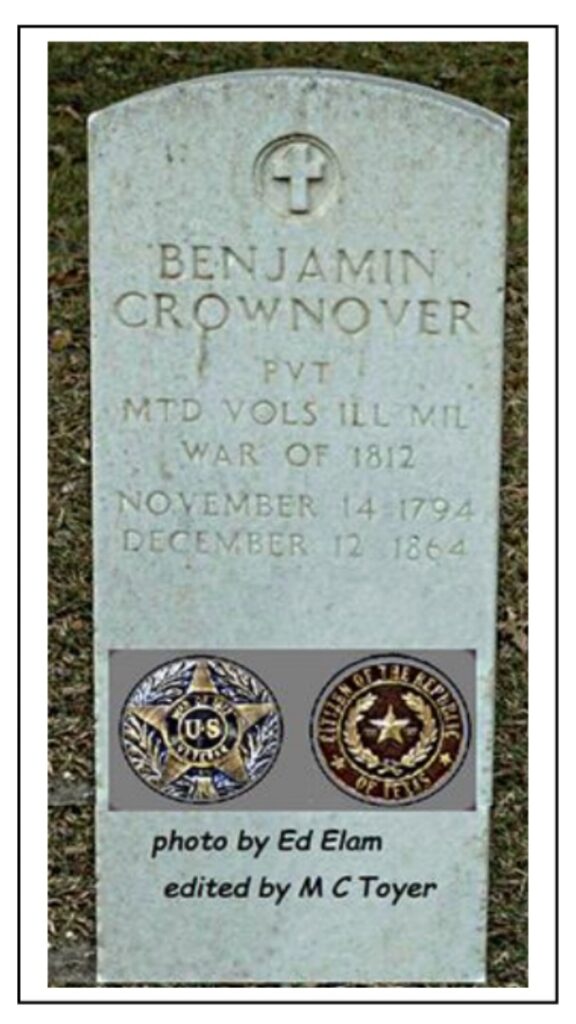
Benjamin Crownover was born on November 14, 1794 at Grindal Shoals, Union County, South Carolina, to John Crawford and Mary Elizabeth (Chesney) Crownover.
By 1808 the family had removed to Kentucky, then a second move prior to 1812 to St Clair County, Illinois.
Benjamin enlisted in Captain Jacob Short’s Illinois Ranger Company on May 16, 1815 and served until October 5 of the same year. The company operated primarily out of Fort Russell near Edwardsville in present Madison County which is on the east side of the Mississippi River opposite St Louis, Missouri.
On April 18, 1818, Benjamin Crownover married Nancy Robbins at Pecan Point, Miller County, Arkansas.
The western boundary of Arkansas Territory and the State of Arkansas was not firmly established until 1845 and prior to that Miller County included large parts of northeast Texas and southeast Oklahoma / Indian Territory. On the Texas side it included the settlements of Jonesborough and Pecan Point on Red River and the town of Clarksville which was also the Red River County Seat. Some of these places are reported as their marriage and birth place of some of their twelve children. Benjamin had patented land and resided in Hempstead County, Arkansas in the 1830s which was located in the east side of Miller County, Arkansas.
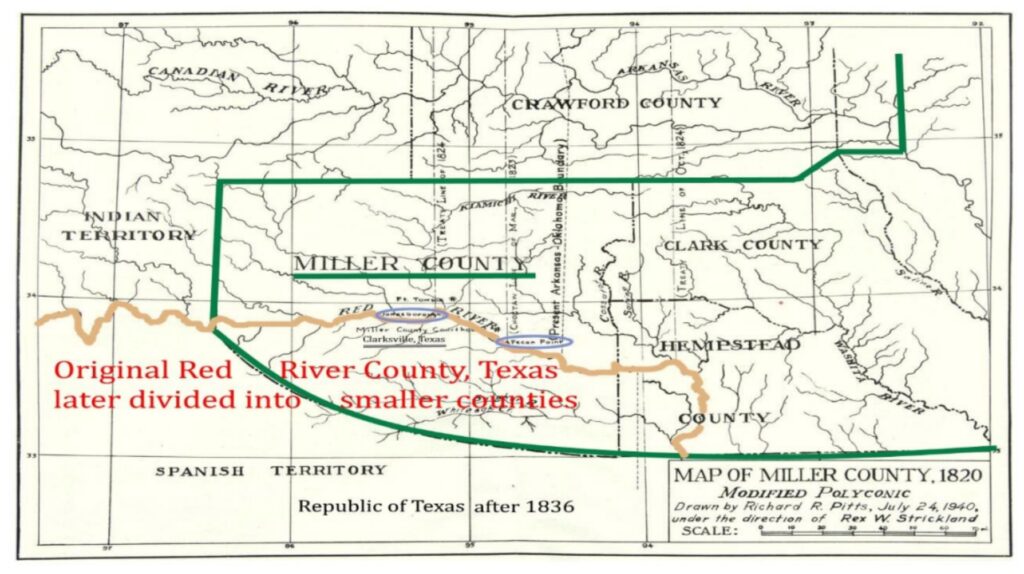
In September 1837, Benjamin Crownover registered for a 2nd Class Headright Grant in Red River County, Texas. He received his conditional certificate for 1280 acres on October 4, 1838. The land was surveyed in two tracts on April 16, 1839; one was 10 miles west of Clarksville and the other about 9 miles south of there near Bogota, Texas, both in Red River County. The southern tract was adjacent to Blossom Prairie.
Benjamin Crownover enlisted in W B Stout’s Red River County Ranger Company of the 1st Regiment, 4th Brigade Texas Militia headquartered at Clarksville on November 26, 1838, The campaign was a part of the 500 man Rusk – Dyer Expedition which ranged from the Sabine River westward to the Three Forks and Cross Timbers regions of north central Texas in pursuit of renegade Native Americans who had been targeting and attacking settlers in the area. He was discharged six months later on May 26, 1839 and the family began to settle into their new home. By this time there were five surviving children.
In July 1840, Benjamin Crownover and Alexander W Webb, his future son-in-law, were witnesses for the Headright Grant registration of William Bolin Cox, a recent immigrant from Greene County, Illinois. Webb had migrated from the same place the year before. It is not known if Crownover and Webb were acquainted prior to that time.
Alexander Webb married Benjamin and Nancy Crownover’s oldest daughter, Lucinda, at Blossom Prairie, adjacent to the Crownover homestead near Bogota on May 3, 1841.
A week later Alexander joined James Bourland’s hastily assembled company of volunteers in pursuit of the renegade Native Americans who were still raiding the settlements and isolated homesteads. Accompanied by General Edward Tarrant, the 4th Brigade Commander, the volunteers attacked a large encampment of several tribes on the West Fork of the Trinity on May 24, 1841. Realizing they were severely outnumbered and Captain John B Denton had been killed and Henry Stout wounded, Tarrant ordered a withdrawal and returned to northeast Texas to recruit a larger force.
Alexander once again rode out, this time with the entire 4th Brigade departing from Fort Inglish (present Bonham in Fannin County) on the 15th of July, 1841. When they reached the encampments they found the Native Americans had fled. The Brigade followed the trail up the West Fork of the Trinity for about 50 miles without making contact so General Tarrant ordered they return to the settlements in northeast Texas for additional supplies. Arriving on August 7, he decided to form two smaller companies from the Brigade. One would go in search of two young boys who had been kidnapped while they were away; the other would return to the area of the May 24th battle and construct a fort to keep the area safe for settlement. The fort was named for Jonathan Bird, Brevet Major of the Battalion of the two companies.
Alexander Webb was elected Captain of the second Company. Recruiting was delayed as the volunteers needed to gather in their crops, but they finally departed in late September. On arrival, a site on a small lake on the north side on the West Fork about 5 miles distant from the battle area was selected. After a stockade and two blockhouses were completed some of the rangers returned to bring out their families to settle permanently, as they would receive additional land grants for doing so in the vicinity of the fort. Benjamin and Nancy Crownover came with their five children, including Lucinda, Alexander’s bride.
Birds Fort was forced to be abandoned in the spring of 1842 due to the expansion of the Peters Colony land grant. The Crownover and Webb families returned to their homes in Red River County. Alexander Webb had received a 4th Class Headright Grant for 640 acres in 1842, but he sold the certificate to James Ward in 1850 without ever having surveyed or lived on the land. It is most likely he lived and worked on one of the two Crownover tracts since Benjamin’s oldest surviving sons were only teenagers or younger then.
In the 1840’s, after returning to Red River County, Benjamin Crownover served several terms as Justice of the Peace. In 1849, he also sold his Red River lands to James Ward.
About 1851, the Crownover and Webb families removed to Dallas County and filed for pre-emption land grants near the east county line in the Long Creek Community, each receiving about 320 acres, where they would live out their lives. Parts of the surveys adjoined and the Long Creek Cemetery, Church and School were in between, on land donated by the families.
In the spring and summer of 1860, Dallas County raised a Company of Mounted Rangers in an unsuccessful campaign to force the Native Americans to return to their reservations in central Texas. Nicholas Darnell was Captain, John Neely Bryan was First Lieutenant, Alexander Webb was Second Sergeant and Benjamin Crownover was a Private.
Only six of the Crownover’s twelve children live to reach adulthood. The youngest surviving son, Benjamin Crownover Junior, was born in 1835. He married Sally Davis in Dallas in 1855, enlisted in the Mesquite Light Horse Company, 13th Brigade, Texas State Troops in 1861, but was killed in 1862 in a gunfight.
Other than Lucinda, only two of the Crownovers’ surviving daughters married; Elizabeth, born in1833, married Hugh Curtis Caldwell in Dallas in 1857, and Cynthia Ann, born in 1843, married Marion Able Coats in Dallas in 1858. The surviving spinsters apparently lived at home until their deaths.
Benjamin Crownover was a prosperous farmer and stockman with almost 500 head of horses, cattle, sheep and hogs. Alexander Webb was primarily a farmer and dairyman with about 200 head but also grew Indian corn, oats and produced copious amounts of butter.
In letters to his relatives in 1862, Benjamin related the extended families were mostly well and living nearby, but a lack of rain and shortage of manpower due to the war was creating hardships.
Benjamin Crownover passed away at home in 1864. His wife Nancy passed was a widow another 22 years, passing at age 90 in 1886. Both are buried in the Long Creek Cemetery in present Sunnyvale, Dallas County, Texas.
Get future posts by email.